

Why Ice Hockey Betting Deserves Your Attention
Nine years ago I placed my first hockey bet — a moneyline on the Sheffield Steelers against Belfast — and lost. Not because the pick was wrong (Sheffield won by two), but because I had no framework, no process and no idea what I was looking at beyond a gut feeling. That loss cost me twelve quid and bought me an obsession. I have spent every season since then building models, tracking line movements and pulling apart the numbers behind ice hockey betting. This guide is what I wish someone had handed me on day one.
Ice hockey sits in a peculiar spot for UK punters. It is not football, not rugby, not racing — and that is precisely its advantage. The UK gambling industry generated GGY of 16.8 billion pounds in the year to March 2025, with remote betting alone accounting for 2.4 billion pounds, dominated by football and horse racing. Hockey barely registers as a line item. That lack of mainstream attention means bookmaker pricing on ice hockey is less efficient, models are less contested and edges last longer than they do in saturated markets.
16.8 billion pounds
UK gambling industry GGY, year to March 2025
1.32 million
EIHL attendance in 2025-26 — a fourth consecutive record
7.5-8 billion dollars
Projected NHL revenue for the 2025-26 season

Meanwhile, the sport itself is booming. The EIHL set an all-time attendance record for the fourth straight season, drawing 1,321,128 fans through the gates in 2025-26 at an average of 3,863 per match. Across the Atlantic, the NHL projects revenue between 7.5 and 8 billion dollars for this season, with arena attendance hitting 23.16 million at roughly 96 percent capacity. Commissioner Gary Bettman put it simply: "Every platform, every source of revenue is growing." More eyeballs, more broadcast deals, more betting partnerships — and more opportunities for anyone willing to do the analytical homework.
What follows is a pillar guide covering every dimension of hockey betting that matters to a UK-based punter. Markets, strategies, league differences, bankroll discipline, bookmaker selection, integrity concerns and responsible gambling tools — all built on data, not hunches. Whether you are placing your first NHL moneyline or refining a Corsi-based model, the structure here will give you a framework you can actually use.
The Numbers and Edges That Matter Most
- Hockey betting thrives on inefficiency — the UK market is dominated by football and racing, leaving ice hockey lines less sharply priced and edges more durable.
- Road underdogs cover the +1.5 puck line roughly 60 percent of the time, and home teams win 56.6 percent of NHL games — know both numbers before you bet a side.
- Advanced metrics (Corsi, Fenwick, xG) are publicly available and largely ignored by recreational bettors. Teams with a CF% above 52 and a PDO regressing toward 1.000 are your watchlist starters.
- Always confirm the starting goaltender before placing any wager — a single goalie scratch can move the moneyline by 30 cents.
- Bankroll discipline (quarter-Kelly or flat 2 percent stakes) and a 20 percent monthly drawdown limit are what keep an edge compounding instead of collapsing.
Core Hockey Betting Markets Every UK Punter Should Know
I remember staring at an NHL coupon for the first time and thinking it looked like a spreadsheet written in another language. Moneyline, puck line, period totals, player props — the terminology wall is real, and it keeps people out. That is a shame, because once you understand the four core market types, hockey betting becomes one of the most logically structured sports to wager on. Every market answers a different question about the game, and choosing the right one is half the battle.
What separates a sharp hockey bettor from a recreational one is not picking more winners — it is picking the
right market for each situation. A heavy favourite might be a terrible moneyline bet but an excellent puck
line play. A low-scoring goaltending duel screams under rather than a side. The sections below break down each
market type so you can match your analysis to the wager that extracts the most value.
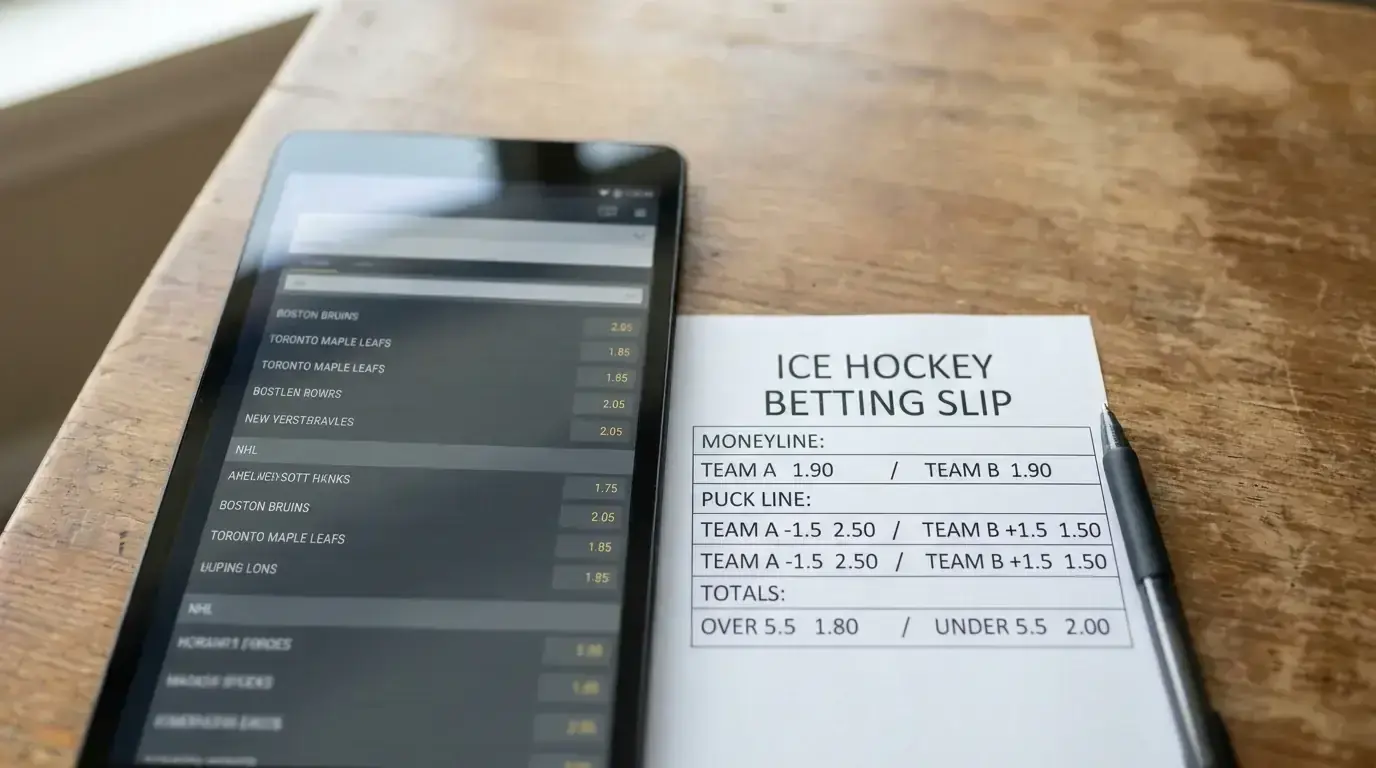
For a deeper dive into how odds are priced and where mispricings hide, I have a separate piece on how hockey betting odds work.
Moneyline and Match Winner
The moneyline is the purest bet in hockey: pick the team that wins, full stop. No spread, no handicap, no margin of victory. If your side wins 1-0 in overtime or 7-2 in regulation, the payout is the same. In UK decimal odds, a moneyline on a moderate favourite might look like 1.65 while the underdog sits at 2.30. That pricing tells you the bookmaker believes the favourite wins roughly 60 percent of the time.
Example moneyline calculation
Suppose Team A is priced at 1.75 and Team B at 2.15. A 10 pound stake on Team A returns 17.50 if they win (7.50 profit). Team B returns 21.50 (11.50 profit). The implied probabilities: Team A = 1 / 1.75 = 57.1%, Team B = 1 / 2.15 = 46.5%. Those probabilities sum to 103.6% — the extra 3.6% is the bookmaker's overround, their built-in margin.
The moneyline works best when you have a genuine opinion on the outcome but the margin of victory is uncertain. In hockey, one-goal games are extraordinarily common — roughly half of all NHL contests are decided by a single goal. That frequency makes the moneyline a cleaner expression of your view than a handicap in many situations. The flip side: heavy favourites carry short prices that compress your returns, and a single overtime loss wipes out the bet just the same as a blowout defeat.
Moneyline — a straight-up bet on which team wins the game, including overtime and shootouts. In UK markets, also listed as "match winner" or "1X2" when offered as a three-way (regulation time only).
Puck Line and Handicap Betting
The puck line is hockey's version of the point spread, and it almost always sits at plus or minus 1.5 goals. If you back the favourite at -1.5, they need to win by two or more. If you take the underdog at +1.5, they can lose by one and your bet still lands. It sounds like a minor adjustment, but it transforms the economics of every wager.
Example puck line pricing
Favourite at -1.5: decimal odds 2.40. Underdog at +1.5: decimal odds 1.55. A 10 pound stake on the favourite at -1.5 returns 24.00 if they win by two or more. The underdog at +1.5 returns 15.50 as long as they keep the game within one goal or win outright.
Here is the number that makes puck line betting fascinating: road underdogs cover the +1.5 line approximately 60 percent of the time in the NHL. That is a persistent trend driven by the sport's tight competitive balance. Most games are close, and a one-goal loss still covers the spread for the underdog. This does not mean blindly backing every away dog is profitable — the odds already reflect the cover rate to some degree — but it does mean the +1.5 underdog market is where I start my analysis on most game nights.
Puck line — a handicap bet set at plus or minus 1.5 goals, analogous to a spread in other sports. Alternative puck lines (plus or minus 2.5, 3.5) are available at adjusted prices. For a full breakdown of when to use the puck line versus the moneyline, see the dedicated puck line betting guide.
Totals (Over/Under Goals)
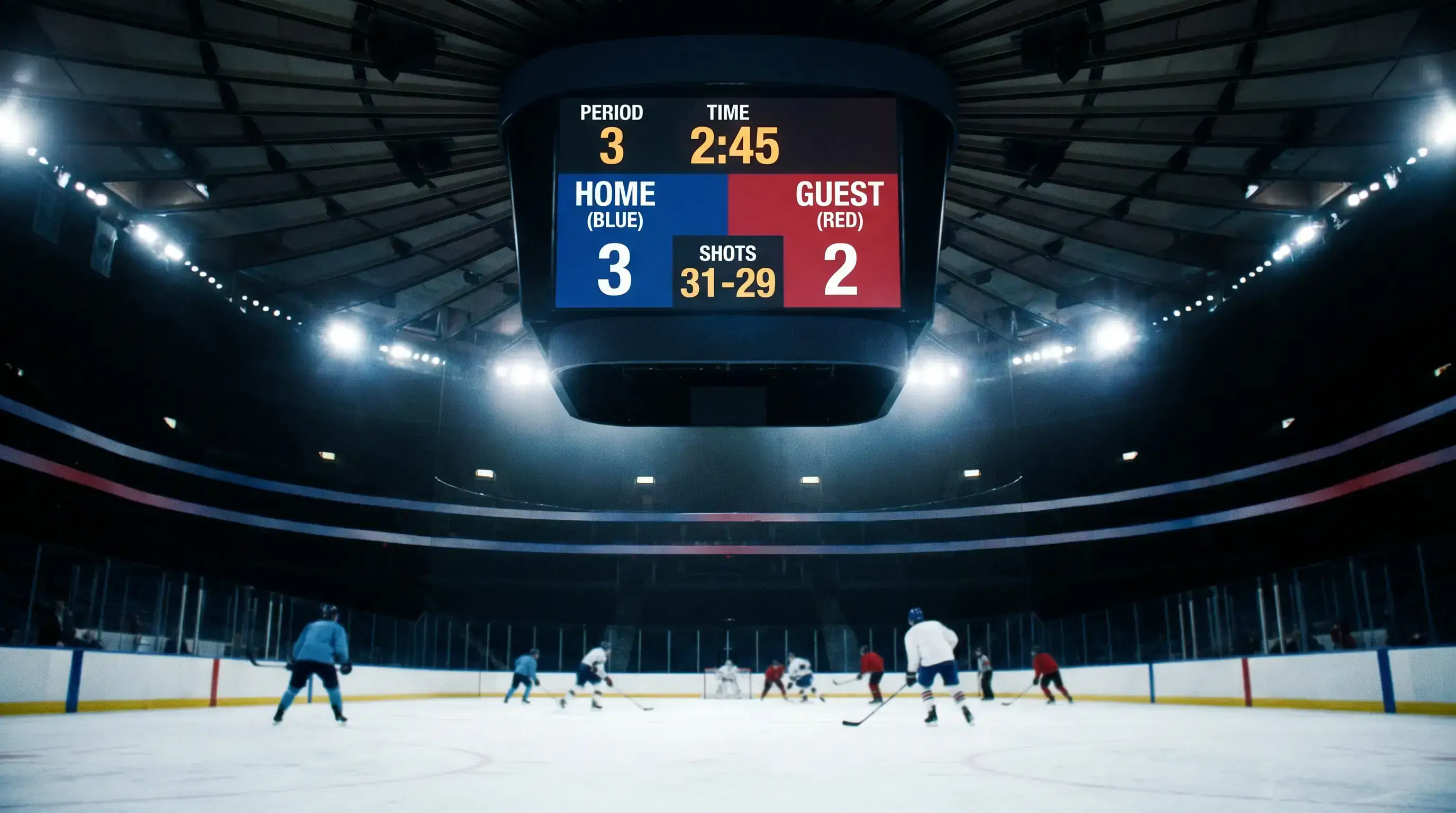
Totals betting strips away which team wins and focuses entirely on combined scoring. The bookmaker sets a goals line — commonly 5.5 or 6.0 in the NHL — and you decide whether the final combined score will land over or under that number. I find totals to be the most model-friendly market in hockey because scoring is driven by measurable inputs: pace of play, goaltender form, power play frequency and shooting volume.
Example totals pricing
Over 5.5 goals at 1.90. Under 5.5 goals at 1.90. If the game finishes 4-2 (six total goals), the over wins. If it finishes 3-2 (five total goals), the under wins. At 5.5, there is no push — the half-goal eliminates ties.
One trend worth noting: NHL games with a posted total of 6.5 have gone under roughly 57 percent of the time in recent seasons. Bookmakers know the public loves goals, and they shade totals slightly high to balance action. That systematic bias toward overs among recreational bettors can create value on the under side, especially in matchups between elite goaltenders or disciplined defensive systems.
Totals (over/under) — a bet on the combined number of goals scored by both teams. Lines at whole numbers (6.0) can result in a push (stake returned) if the total lands exactly on the line.
Player Props and Specials
Player props are where hockey betting gets genuinely interesting — and where the least efficient pricing lives. These markets let you bet on individual performances: shots on goal over/under, anytime goal scorer, assists, saves, even penalty minutes. Because props require the bookmaker to price dozens of individual players per game rather than just two teams, the lines are thinner, the models are rougher and the opportunities for an informed bettor are wider.
NHL teams average around 30 shots on goal per game, but individual players can range from two to six depending on role and matchup. That variance is what makes shots-on-goal props one of the most exploitable markets in hockey betting — small edges on high-volume events compound quickly over a season.
Specials markets extend beyond individual players. You might bet on which period will see the most goals, whether both teams score in every period, or the exact correct score. These are higher-variance plays with bigger payouts and wider margins. I use them sparingly — mainly when my game model flags a structural mismatch that standard markets do not capture, like a top power play unit facing a bottom-five penalty kill where the player prop and period scoring markets both tilt in the same direction.
Five Strategies That Give You an Edge
Last January I had a three-week stretch where every model I ran pointed the same direction: under bets on Central Division road games involving teams on the second night of a back-to-back. It felt too specific to be real. But the data was clean, the sample was large enough and I trusted the process. That stretch ended up being my most profitable month of the season — not because I found some secret, but because I stacked three separate edges (fatigue, travel, goaltending splits) into a single thesis.
The strategies below are not tricks. They are structural features of how ice hockey works that translate into repeatable betting advantages. Some are well-known among sharp bettors but poorly understood by the public. Others are genuinely underused, even by people who should know better. Each one is backed by data I track season over season, and each one has cost me money when I ignored it.
Do
- Layer multiple edges before committing a stake — form plus schedule plus goaltending alignment is the sweet spot
- Track advanced metrics (Corsi, xG, PDO) weekly, not just when you feel like it
- Confirm the starting goaltender before every bet
- Use period-specific and player prop markets when your model flags a structural mismatch
Don't
- Bet on a heavy favourite at short odds without checking the puck line alternative
- Ignore schedule context — a back-to-back on the road is not the same as a rested home start
- Chase a losing streak by increasing stake size
- Rely on team reputation or recent headlines instead of underlying possession data
Every strategy below works best at specific price points. An edge that is profitable at 2.10 can be a losing proposition at 1.85. Before committing to any approach, check whether the current odds still offer value — not just whether the underlying thesis is correct.

Home Ice Advantage by the Numbers
56.6%
NHL home team win rate in 2024-25
+1.5 cover rate
Road underdogs cover roughly 60% of the time
Last change
Home teams get the final line change, a tactical edge unique to hockey
Home ice advantage in the NHL is real and measurable. During the 2024-25 season, home teams won 56.6 percent of their games — a margin that has held remarkably steady across decades. The advantage comes from three sources: the last line change (allowing the home coach to deploy favourable matchups), the energy of a home crowd on momentum swings and the absence of travel fatigue.
But here is the catch that trips up most bettors: the bookmakers know this too, and they price it in. Home favourites are often overpriced because the public gravitates toward the home side. The real edge is not in blindly backing the home team — it is in identifying the specific situations where home ice advantage is either amplified (rivalry games, playoff atmosphere, strong home record against a specific opponent) or diminished (a home team on the back end of a home-and-home set, a team with a poor record in matinee games). The 56.6 percent win rate is a baseline, not a strategy. What you do with the outliers above and below that number is where the money lives.

Third-Period Scoring and Live Value
If you have ever watched an NHL game from puck drop to final horn, you already know this instinctively: the third period is chaos. Legs are heavy, systems break down and desperate trailing teams pull their goaltender for an extra attacker with two minutes left. That desperation creates goals — and goals create value for anyone paying attention to period-specific markets.
The third period is the highest-scoring period in the NHL. Teams attack more aggressively as fatigue mounts and tactical caution evaporates. Live bets on "over 1.5 goals in the third period" have shown positive returns across recent seasons, particularly in games that enter the final frame tied or within one goal.
I use this in two ways. First, pre-match: if my model projects a close game between two high-event teams, I look at the period totals market rather than the full-game total. The full-game line might be efficiently priced at 6.0, but the third-period over could be offering value that the full-game line does not capture. Second, live: when I am watching a game and the score is tight entering the third, I look at the in-play third-period total. The combination of fatigue, urgency and empty-net situations creates a structural scoring bump that live odds often lag behind, especially in the opening minutes of the period before a goal has been scored. For a full treatment of live betting mechanics, I have written a separate ice hockey live betting strategy piece.
Using Corsi, Fenwick and xG for Betting
This is where hockey betting diverges from every other sport I have worked with. No other major sport has such a rich, publicly available set of possession and shot-quality metrics — and no other sport's betting public ignores them so thoroughly. If you learn three acronyms, you will already be ahead of 90 percent of the recreational market.
Corsi — the total number of shot attempts (shots on goal, missed shots and blocked shots) by a team or player. Corsi For Percentage (CF%) measures what share of all shot attempts at 5-on-5 belong to the team. A CF% above 52% is considered very good; above 55% for a full season puts a team in the top five of the league.
Fenwick — similar to Corsi but excludes blocked shots, isolating unblocked shot attempts. Some analysts prefer Fenwick because blocked shots can reflect opponent shot volume rather than offensive generation.
Expected Goals (xG) — a model that assigns a scoring probability to each shot based on location, angle, shot type and game situation. xG captures shot quality, not just shot quantity. A team that generates 2.8 xG but scores one goal is not playing badly — they are running into variance.
In the 2024-25 season, eight out of ten teams with the best CF% reached the playoffs. Corsi is not a crystal ball, but it is one of the strongest publicly available indicators of team quality — and most bookmakers still set their lines primarily off recent results and public perception, not off possession data. That gap between perception and underlying quality is where the value sits.
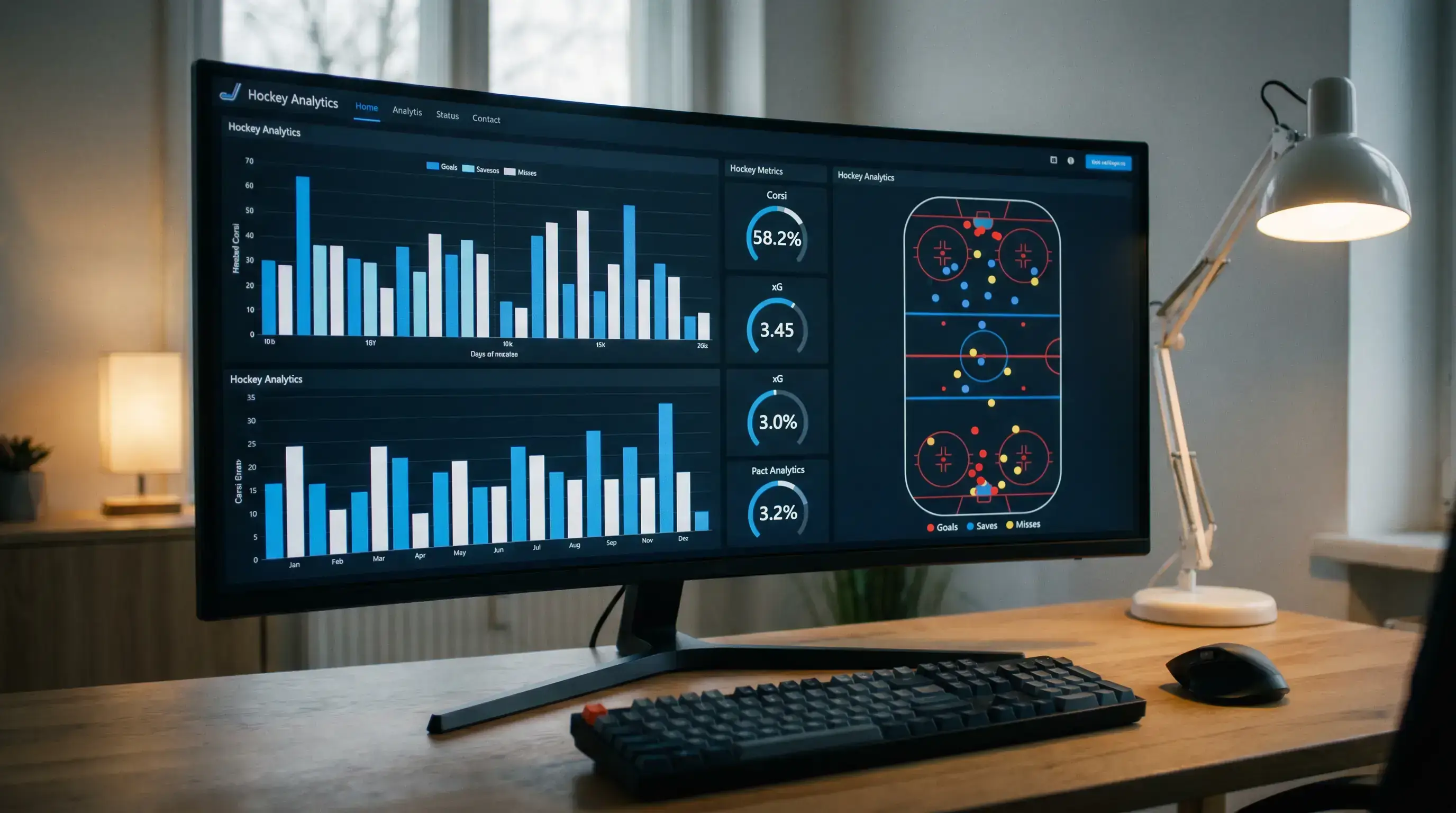
The analytical insight that matters most for bettors is about sustainability. NetNewsLedger's hockey analytics team nailed it: "If a team has a PDO significantly above 1.000, it often suggests that their high win rate may not be sustainable, especially if their shot quality and possession metrics don't match the output." PDO is the sum of a team's shooting percentage and save percentage. When both are elevated, the team is riding luck. When they regress — and they always do — the line has not adjusted yet. That is your window. I build my weekly watchlists around teams with a CF% above 52 and a PDO trending back toward 1.000 from either direction.
Goalie Form and Its Impact on Lines
I once watched a moneyline shift by 30 cents in 20 minutes because a starting goaltender was scratched from the lineup with an undisclosed lower-body issue. No other position in professional sport has that kind of singular influence on a betting line. As one analyst at The Score WI put it: "No position in hockey influences betting outcomes quite like goaltending. A hot goalie can single-handedly steal games, while a struggling netminder can sink even the best teams."
Always confirm the starting goaltender before placing any hockey bet. NHL teams typically announce starters by mid-morning on game day, and the line will move within minutes of confirmation. Betting before the announcement is gambling blind — you are effectively taking a position on two different possible matchups at once.
The metrics that matter are save percentage (SV%) and goals against average (GAA), but context elevates them. A goaltender posting a .925 SV% behind a team that allows 35 shots per game is performing significantly better than one posting the same number behind a team that allows 25 shots per game — because he is facing more high-danger chances. I weight goalie form over the last ten starts rather than season averages, and I compare it against the opposing team's expected goals per game to get a sense of whether the line has properly accounted for the matchup.
Starter versus backup splits are equally critical. Some NHL teams carry a clear number-one goaltender who plays 55-60 games per season. When the backup gets the start — often on the second night of a back-to-back — the line adjusts, but not always enough. Backup starts correlate with higher totals and lower favourite confidence. If you track which teams have the widest gap between their starter and backup, you have a built-in angle for totals betting every time the backup gets the nod.

Schedule Fatigue and Travel Spots
The 2025-26 season is the final NHL season with an 82-game schedule. Starting in 2026-27, the league expands to 84 games per team. That means even more compressed scheduling, more back-to-backs and more fatigue-driven opportunities for bettors who track rest differentials.
An 82-game NHL season crammed into roughly 180 days produces scheduling asymmetries that are visible in the data. Teams playing the second game of a back-to-back, particularly on the road, show measurable declines in shot generation, defensive structure and win probability. When a team flies from Vancouver to Florida for a Tuesday game after playing in Calgary on Monday night, the physical and cognitive toll is not abstract — it shows up in Corsi numbers, in goaltender workload and ultimately in the final score.
I keep a simple spreadsheet that flags every game where one team has a rest advantage of two or more days over their opponent. That filter alone does not make a bet, but when it overlaps with a backup goaltender start and a travel-heavy road stretch, the cumulative effect is significant enough to move my model output by several percentage points. Schedule fatigue is the closest thing to a free variable in hockey betting — everyone knows it exists, but few people track it systematically enough to exploit it.
Understanding markets and strategies is half the equation. The other half is knowing which league you are betting on — because the NHL and the EIHL are fundamentally different ecosystems for a bettor.
NHL vs EIHL — Two Leagues, Two Approaches
A friend once asked me to help him build a betting model for the EIHL using the same framework I use for the NHL. I told him it was like trying to drive a Formula One car on a country lane — the tools are similar but the terrain is completely different, and the approach that works at 200 miles per hour will get you stuck in a hedge at 40.
NHL
32 teams, 82-game season (expanding to 84 in 2026-27). Revenue projected at 7.5 to 8 billion dollars for 2025-26. Deep public analytics: Corsi, Fenwick, xG, tracking data. Attendance at a record 23.16 million in the regular season. Hundreds of betting markets per game across most UK bookmakers. Tight lines, high liquidity, rapid odds adjustment.
EIHL
12 teams, compact domestic schedule. Record attendance of 1,321,128 in 2025-26, a fourth consecutive record, with an average of 3,863 per match. Ice hockey is the number one attended indoor professional sport in the UK. Limited public analytics — basic stats only. Fewer markets per game, wider margins, slower line movement. Softer odds but lower liquidity.
$7.5-8 billion
NHL projected revenue 2025-26
1.32 million
EIHL total attendance 2025-26
96%
NHL arena capacity utilisation
For the NHL, your edge comes from processing data more rigorously than the market — possession metrics, goaltender matchup models, schedule overlays. The information is all public; the discipline to use it systematically is not. For the EIHL, the edge is entirely different: local knowledge, roster familiarity and the ability to spot value in markets where the bookmaker has devoted minimal analytical resources to pricing. EIHL lines are set with less data and less sophistication, which means they are wider but also less predictable.
The EIHL's growth trajectory is striking. Attendance has climbed from just over a million in 2022-23 to 1.32 million this season, with average figures up 15 percent year on year as recently as January 2026. That growth is pulling more bookmaker attention — and more markets — toward the league. I expect EIHL betting markets to deepen significantly over the next two to three seasons as the audience continues expanding. For now, the league sits in a sweet spot where the betting infrastructure is developing but the pricing sophistication has not caught up.

One thing both leagues share: the fundamentals of value identification are the same. You are always looking for a gap between what the odds imply and what your analysis suggests. The difference is the tools you use to find that gap and the size of the gap when you find it. NHL gaps are small and require precision. EIHL gaps can be wider but come with less data to validate them.
Bankroll Management for Hockey Bettors
I blew through my first hockey bankroll in three weeks. Not because my picks were bad — my win rate that stretch was actually above 55 percent — but because I was staking 10 percent of my pot on every bet and a four-game losing run wiped out the gains from the previous twelve winners. That experience taught me the most important lesson in this entire guide: bankroll management is not optional discipline for serious bettors. It is the structural foundation that determines whether your edge actually translates into profit over a season.
Simplified Kelly Criterion calculation
Suppose your model gives Team A a 58% chance of winning, and the decimal odds are 1.90. The Kelly formula says: stake = (probability x odds - 1) / (odds - 1). Plugging in: (0.58 x 1.90 - 1) / (1.90 - 1) = (1.102 - 1) / 0.90 = 0.113, or 11.3% of bankroll. In practice, most sharp bettors use "fractional Kelly" — typically one-quarter to one-half of the full Kelly amount — to reduce volatility. So you would stake roughly 3 to 6 percent of your bankroll on this bet.
The two dominant approaches are flat staking and percentage-of-bankroll models. Flat staking means every bet is the same amount — say, 2 percent of your starting bankroll — regardless of confidence level. It is simple, robust and hard to mess up emotionally. Percentage models adjust the stake to your current bankroll, so you bet more when you are up and less when you are down. The Kelly criterion, shown above, optimises for maximum long-term growth but can recommend uncomfortably large stakes. I use a quarter-Kelly approach for NHL bets and flat 1.5 percent stakes for EIHL, where my sample sizes and model confidence are lower.
Pre-bet process — run through this before every wager
- Starting goaltender confirmed for both teams
- Schedule context checked — back-to-back, travel distance, rest differential
- Model output reviewed — does the implied probability from your analysis exceed the implied probability from the odds?
- Stake sized according to your system — no emotional overrides
- Bankroll updated post-bet — win or loss, log the result and adjust your running total

Set a session ceiling and a drawdown limit. My rule is simple: if my bankroll drops 20 percent from its peak in any calendar month, I stop betting for the rest of that month and review my model. That rule has saved me from compounding bad runs more times than I care to count. The goal is to survive the variance long enough for your edge to compound. An 82-game NHL season — or the 84-game season coming from 2026-27 — gives you hundreds of opportunities. You do not need to win them all. You need to be solvent for enough of them.
Interactive tool
Value & Kelly stake calculator
Enter your own win estimate and the bookmaker's decimal odds. The tool shows the implied probability, whether there's a genuine edge, and a disciplined stake based on the Kelly criterion. No edge means no bet.
- Recommended stake £14.14
- Implied probability (from odds) 52.6%
- Your edge vs the odds +5.4 pts
- Expected value per £1 staked +10.2%
Choosing a UK Bookmaker for Ice Hockey
Not every UK bookmaker treats ice hockey the same way, and the difference between a platform that takes hockey seriously and one that offers it as an afterthought is enormous. I have had accounts where the NHL moneyline was available but nothing else — no period markets, no player props, no live betting, no EIHL coverage. That is fine if all you want is a simple pre-match side. It is useless if you are trying to exploit the edges I have described above.
UK remote betting generated 2.4 billion pounds in GGY during the year to March 2025, with football and racing accounting for the vast majority. Ice hockey's share is tiny — but that is exactly why operators who do invest in hockey coverage tend to offer less efficient pricing. They have fewer sharp bettors calibrating their lines.
When evaluating a bookmaker for hockey, I look at five things in order of importance: market depth (do they offer puck lines, period totals, player props, alternative lines and live markets?), odds competitiveness (compare moneylines across three or four platforms per game — the differences are often 5 to 10 cents), league coverage (NHL is standard, but EIHL, SHL, Liiga and KHL coverage varies wildly), live betting quality (speed of line updates, breadth of in-play markets, cash-out availability) and withdrawal reliability (because the best odds in the world are worthless if you cannot get your money out promptly).
The NHL has leaned aggressively into betting partnerships in recent years. FanDuel became the league's first official betting partner in North America, and the NHL broke new ground by signing deals with prediction market platforms Kalshi and Polymarket — the first major sports league to do so. Kalshi's CEO, Tarek Mansour, called the partnership "an important milestone" and "a testament to the integrity, safety, and trust with consumers that Kalshi has spent years building." These partnerships matter for UK bettors indirectly: they drive data transparency, increase market liquidity globally and signal that the NHL views betting as a core part of its commercial future rather than something to be tolerated.
I run three active accounts specifically for hockey and compare odds before every bet. The time investment is about two minutes per game. Over a season, that two-minute habit has added more to my bottom line than any single analytical insight.

Betting Integrity and What the Rules Say
Most hockey bettors never think about match-fixing because it feels like something that happens in lower-tier football leagues, not in a sport with salaries in the millions. That complacency is dangerous — and the governing bodies of ice hockey do not share it. Approximately one billion euros is wagered on hockey annually, and at the Winter Olympics, hockey has historically been the sport with the highest betting volume. Where that much money flows, manipulation pressure follows.
The IIHF prohibits all betting on ice hockey by anyone involved in the sport — players, coaches, officials, support staff. Tom Wijckmans of the IIHF Legal Department has stated it clearly: "Betting is not all bad and on the contrary is a major contributor to revenue in sport, but there is a very high risk of competition manipulation. Therefore, it is forbidden for everyone working in ice hockey to bet on any ice hockey games."
The consequences of crossing that line are severe and personal. Former Danish national team player Kirill Starkov described his own experience: "Everything changed after I bet on my own game. I placed a bet that the opposing team would score a goal within the first two periods." His career and reputation were destroyed. The IIHF uses these cases in its integrity education programmes precisely because they are real, not hypothetical.
For UK bettors, the practical takeaway is vigilance. If you see sudden, unexplained line movement on a lower-tier hockey league — a game that shifts from pick'em to a heavy favourite in minutes without any public news — treat that as a red flag, not an opportunity. Sharp line movement in major leagues like the NHL usually reflects injury news or goaltender changes. In smaller leagues with less monitoring infrastructure, unusual movement can signal something uglier. I do not bet games where the line moves in ways I cannot explain. The integrity of the market is something we all benefit from protecting, and it starts with choosing not to chase suspicious prices.
Responsible Gambling — Tools That Actually Work
I write about edges, models and bankroll systems for a living, but none of it matters if the activity stops being enjoyable. Gambling participation in the UK stands at 48 percent of the adult population, with 10 percent of those surveyed active on sports betting. Those numbers mean millions of people engage with this market — and the industry has a responsibility to make sure the tools for staying in control are accessible and effective.
A survey of US bettors found that 84 percent were aware of at least one responsible gambling tool, and 91 percent rated credit limits as effective. The tools exist. The challenge is getting people to activate them before they need them rather than after.
The UK Gambling Commission has made responsible gambling a regulatory priority, and its former CEO Andrew Rhodes signalled the direction clearly: "We want to see you harnessing the same innovation and tools that are used to determine customer profitability, to drive customer protection." That means deposit limits, loss limits, session time alerts, reality checks and self-exclusion programmes are not afterthoughts — they are expected features of any licensed UK platform.
Do
- Set deposit limits on every betting account before you place your first wager
- Use session time reminders — they break the absorption loop that leads to chasing
- Keep a written log of every bet, win or loss, to maintain awareness of your actual position
- Treat your betting bankroll as a separate budget line, not a pool you top up from general spending
Don't
- Assume that "safer gambling" adverts from operators are neutral — a GambleAware randomised controlled trial found that some operator-designed safer gambling adverts actually increased gambling behaviour, with nearly half of respondents saying those adverts framed gambling as harmless fun
- Bet to recover losses from a previous session
- Ignore early warning signs: betting more than planned, thinking about the next bet during non-betting hours, or feeling irritable when you cannot place a wager
- Hesitate to use self-exclusion tools if you feel your relationship with gambling is changing

If you or someone you know is struggling, GambleAware and the National Gambling Helpline provide confidential support. Self-exclusion through GAMSTOP covers all UK-licensed online operators in a single step. The point of everything in this guide — the data, the strategies, the discipline — is to make hockey betting a sustainable, enjoyable pursuit. The moment it stops being that, the smartest bet you can make is to step away.
Frequently Asked Questions
How does puck line betting work in ice hockey?
The puck line is a handicap set at plus or minus 1.5 goals. If you back the favourite at -1.5, they must win by two or more goals for the bet to pay out. If you take the underdog at +1.5, they can lose by a single goal and your bet still wins. The 1.5-goal line is standard because one-goal games are so common in hockey — roughly half of NHL contests are decided by a single goal. Alternative puck lines at plus or minus 2.5 or 3.5 are available at adjusted odds, giving you more flexibility to match the line to your analysis of a specific matchup.
What is the best strategy for betting on NHL games?
There is no single "best" strategy, but the most consistently profitable approach I have used over nine seasons is layering multiple small edges rather than relying on one. That means combining possession data (Corsi, xG) with schedule context (rest differentials, back-to-backs), goaltender matchup analysis and market selection (choosing the right bet type for the situation). A strong possession team on home ice with their starting goaltender, facing a fatigued opponent on the second night of a road back-to-back, is a confluence of edges — and that is when I size up. Single-factor bets without supporting context are closer to coin flips than investments. For a detailed framework, see my NHL betting strategy breakdown.
Can you bet on ice hockey in the UK?
Yes. Ice hockey betting is fully legal and available through most UK-licensed online bookmakers. The NHL is the most widely covered league, with comprehensive pre-match and in-play markets including moneylines, puck lines, totals and player props. EIHL coverage is growing but remains more limited — not all operators offer EIHL markets, and those that do typically provide moneyline and totals rather than the full range of props and period bets available for NHL games. European leagues like the SHL, Liiga and KHL also appear on many UK platforms. All operators must hold a UK Gambling Commission licence, and the usual age verification and responsible gambling requirements apply.
What does over/under 5.5 goals mean in hockey betting?
An over/under of 5.5 goals means you are betting on whether the total combined goals scored by both teams will be six or more (over) or five or fewer (under). The half-goal eliminates the possibility of a push — there is always a winner. If the game finishes 4-2 (six total goals), the over wins. If it finishes 3-1 (four total goals), the under wins. The bookmaker sets this line based on the expected scoring output of both teams, factoring in goaltender matchups, offensive pace and recent form. Lines at 5.5 and 6.0 are the most common in the NHL, though higher-scoring matchups may be posted at 6.5.
How important is the starting goalie for hockey bets?
Critically important — arguably the single most influential variable in any hockey bet. A goaltender switch from a team's starter to their backup can move the moneyline by 15 to 30 cents and shift the totals line by half a goal. Save percentage, goals against average and recent form over the last eight to ten starts are the key metrics. I treat goalie confirmation as a non-negotiable step in my pre-bet process. If the starter is not confirmed, I do not bet. Period. The gap between a top-tier NHL starter and a replacement-level backup is large enough to flip the value proposition of an entire game.
Is live betting profitable on ice hockey?
It can be, but it demands a different skill set than pre-match betting. Ice hockey moves fast — goals, penalties and momentum swings can shift the odds dramatically within seconds. The third period, in particular, has shown positive returns for over bets on period totals, driven by fatigue and the goalie-pull dynamic in close games. The key to profitable live betting is selectivity. I do not bet in-play on every game. I identify two or three games per night where my pre-match model suggests a specific in-game scenario — trailing team with strong possession metrics, or a game likely to be tight entering the third — and I wait for the price to reach my target.
What are the best UK bookmakers for ice hockey?
The answer depends on what you need. For NHL market depth — player props, period totals, alternative puck lines, live betting — a handful of larger UK-licensed operators consistently outperform the rest. For EIHL coverage, the field is narrower and most bookmakers offer only basic moneyline and totals. Rather than recommending specific brands, I suggest opening accounts with three or four operators and comparing odds on the same game. The differences are often five to ten cents on the moneyline, which over a full season compounds into a meaningful difference in returns. Look for platforms that update lines quickly after goaltender announcements, offer competitive live markets and process withdrawals reliably.
