

Why Betting Integrity Matters Even for Punters
Most bettors assume match-fixing is someone else’s problem — a scandal that happens in a distant league, involving people they will never meet. That assumption is comfortable and wrong. If a game you have wagered on is manipulated, the outcome has nothing to do with the factors your analysis was built on. Your model is irrelevant when the result has been decided before the opening faceoff.
Roughly a billion euros is wagered on ice hockey annually worldwide. At the Winter Olympics, hockey has historically been the sport with the highest betting volume. That scale of money creates incentive, and incentive creates risk. Understanding where that risk is concentrated — and which red flags to watch for — is not paranoia. It is due diligence.
This is not a topic most betting guides bother with. That absence is itself a problem: the more informed the betting public is about integrity risks, the harder it becomes for manipulation to go unnoticed.

IIHF Rules on Betting and Competition Manipulation
The International Ice Hockey Federation takes a hard line on betting within the sport. As Tom Wijckmans from the IIHF Legal Department put it, betting is not all bad and is a major contributor to revenue in sport, but there is a very high risk of competition manipulation — therefore it is forbidden for everyone working in ice hockey to bet on any ice hockey games. The prohibition is absolute: players, coaches, referees, team staff, federation officials. No exceptions, no thresholds, no “friendly wagers.”

The IIHF’s integrity programme includes education workshops at major tournaments, a confidential reporting mechanism, and partnerships with betting monitoring companies that flag unusual odds movements in real time. When a line moves in a direction that contradicts public information — a heavy favourite drifting without any injury news, for instance — the monitoring system alerts the federation for investigation.
For bettors, the practical takeaway is twofold. First, regulated leagues with active integrity programmes are safer markets to bet on. The NHL, KHL, SHL, Liiga and EIHL all operate under integrity frameworks, though the rigour varies. Second, lower-tier leagues with less oversight — junior leagues, regional divisions, exhibition tournaments — carry higher manipulation risk and should be approached with proportional caution. I limit my hockey betting to the top professional tiers for this reason.
Real Cases — What Happens When Players Cross the Line
Kirill Starkov, a former Danish national team player, described the moment his career changed: everything changed after he bet on his own game, placing a wager that the opposing team would score a goal within the first two periods. That single act resulted in a ban and a cautionary story the IIHF now uses in its integrity education sessions.

Starkov’s case is notable because it involved a relatively modest bet on a specific in-game event — not a match result, but a goal-scoring outcome. The manipulation of individual markets (period totals, first goal scorer, next team to score) is harder to detect than a fixed final result because the statistical signature is smaller. A manipulated period total might not move the full-game result at all, making it invisible to casual observers and even some monitoring systems.
Other cases across European hockey have involved organised syndicates approaching players in lower leagues with cash payments in exchange for specific performance actions: taking a deliberate penalty at a prearranged time, ensuring a goal is conceded in a particular period, or influencing the margin of victory. The amounts offered are often modest by professional athlete standards, targeting players on lower salaries who are more vulnerable to financial pressure.

The pattern is consistent: manipulation concentrates where oversight is weakest, salaries are lowest, and betting markets are liquid enough to absorb irregular wagers without immediately triggering alarms. Top-tier leagues are not immune, but the risk is materially lower.
Spotting Red Flags in Odds Movements
I cannot investigate match-fixing. What I can do is recognise when the odds tell a story that contradicts the available information, and choose not to bet on those games.
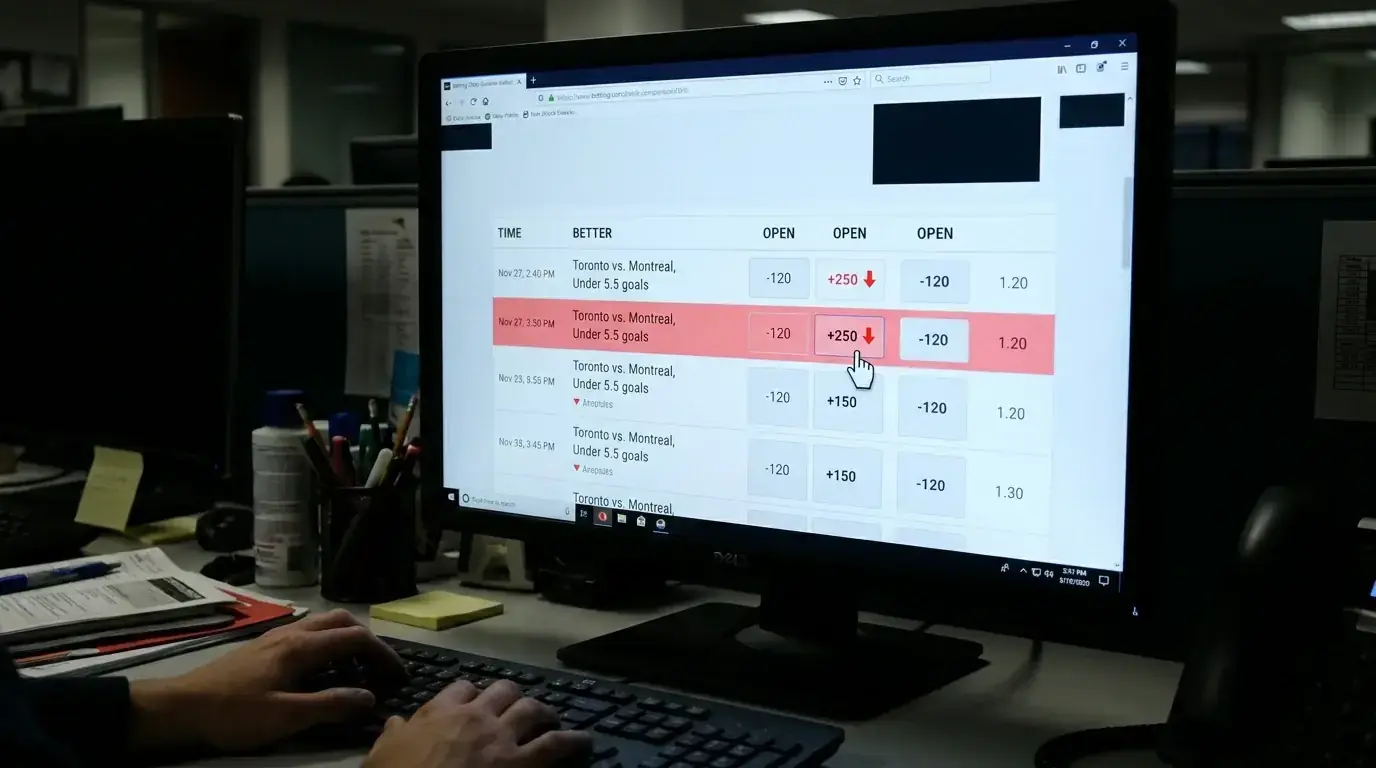
The most common red flag is a significant line move with no public explanation. If a team opens as a -160 favourite and drifts to -130 within an hour, absent any injury news, goaltender change or weather event, something is driving the movement that is not visible to the public. It could be sharp-money action from a well-informed bettor — or it could be something less legitimate. Either way, the information asymmetry means I am operating blind, and I pass on the game.
Unusual volume on minor markets is another signal. If a total or period line that normally attracts minimal handle suddenly sees heavy one-sided action, the imbalance warrants caution. Legitimate sharp bettors tend to target the most liquid markets (moneyline and game total) because they can place larger sums without moving the line. Action concentrated on a niche market — first-period total, specific player prop, exact score — suggests a narrower informational motivation.
I am not suggesting that every unexplained line move indicates fixing. Most of the time, the explanation is mundane: a syndicate with a model edge, a late practice report, an injury that has not hit the news wires yet. But the appropriate response for a bettor is the same regardless of the cause: if you do not understand why the line is moving, do not bet the game. Protecting your bankroll from informational disadvantage is a form of integrity in its own right.
The NHL betting partnerships guide explores how the league’s official sportsbook relationships connect to integrity monitoring and what the expansion of legal betting means for the sport’s oversight framework.