

The Language Barrier That Costs You Money
I spent my first week of hockey betting confused by the word “juice.” I knew what a moneyline was from football, but the American terminology that saturates hockey betting — vig, chalk, dime line, rubber — felt like a second language spoken exclusively to exclude newcomers. That confusion cost me money, because I misread a line, misunderstood a settlement rule, and placed two bets I would never have touched if I had known what the terms meant.
Hockey betting vocabulary blends British bookmaking language, American sportsbook jargon, and ice hockey-specific terminology into a mix that no other sport quite matches. A UK bettor already familiar with football betting needs to learn a new layer of terms to navigate the NHL and EIHL markets confidently. This glossary covers the terms that matter for placing bets, understanding lines, and following the analytical discussions that inform profitable wagering. It is not an encyclopaedia — it is a working toolkit.
Betting Market Terms
The moneyline is the most straightforward hockey bet: pick which team wins the game. In UK formats, this is displayed as decimal odds (1.65, 2.40). American formats use plus and minus notation (+140, -160). Both express the same probability; the conversion is mechanical but worth practising until it becomes second nature. A price of 2.00 in decimal equals +100 in American equals an implied probability of 50%.
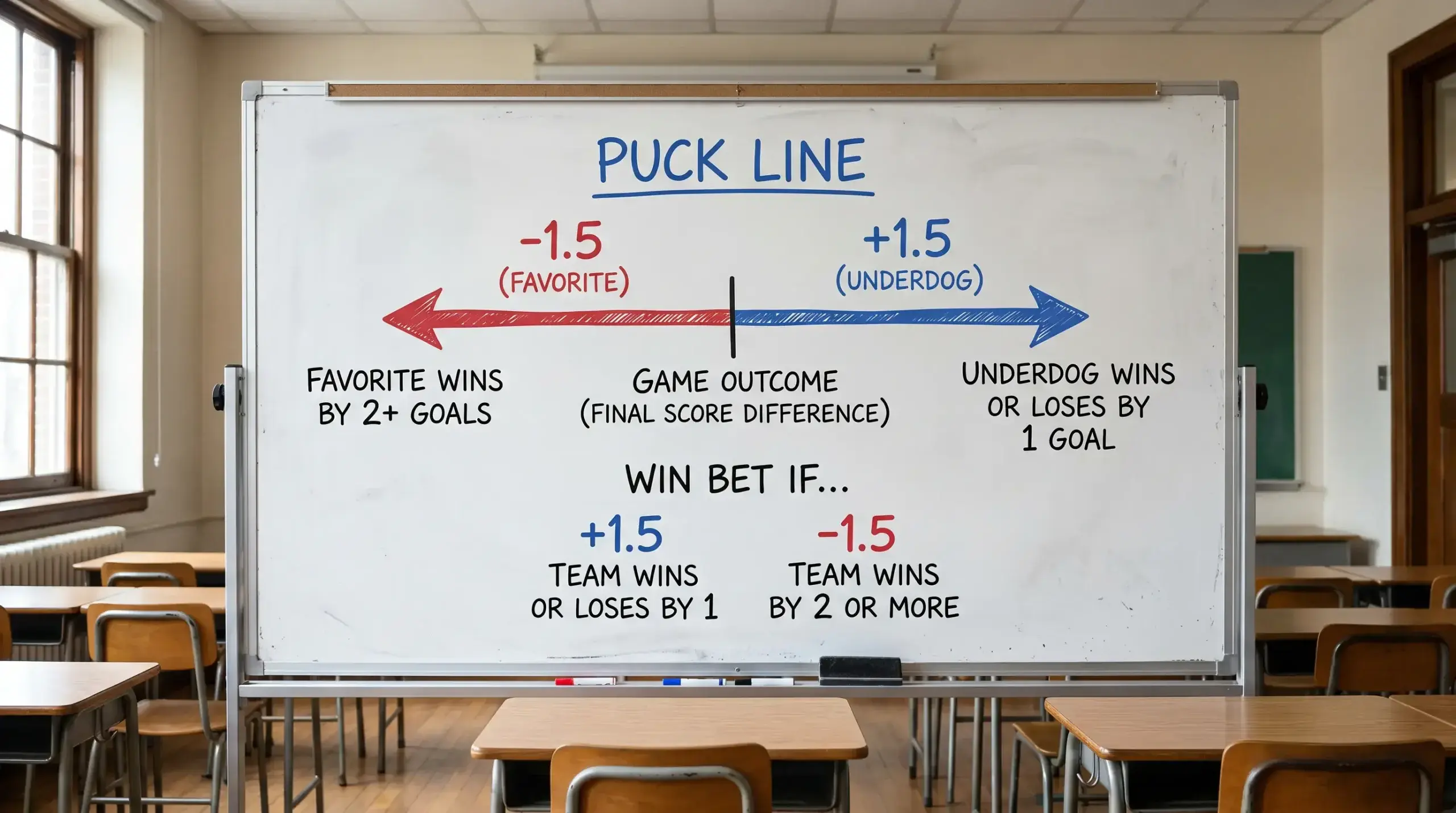
The puck line is hockey’s version of the point spread, fixed at 1.5 goals for standard NHL games. The favourite is -1.5 (must win by two or more) and the underdog is +1.5 (can lose by one and still cover). Road underdogs cover +1.5 roughly 60% of the time in the NHL, making this market one of the most studied edges in hockey. Alternative puck lines at -2.5 or +2.5 are available at some bookmakers for those seeking higher variance plays.
Totals — the over/under on combined goals — sit at 5.5, 6.0 or 6.5 for most NHL games. A total of 6.0 can push (return your stake) if exactly six goals are scored; 6.5 eliminates the push possibility. Period totals apply the same logic to individual twenty-minute periods rather than the full game, offering a way to target specific phases of play.
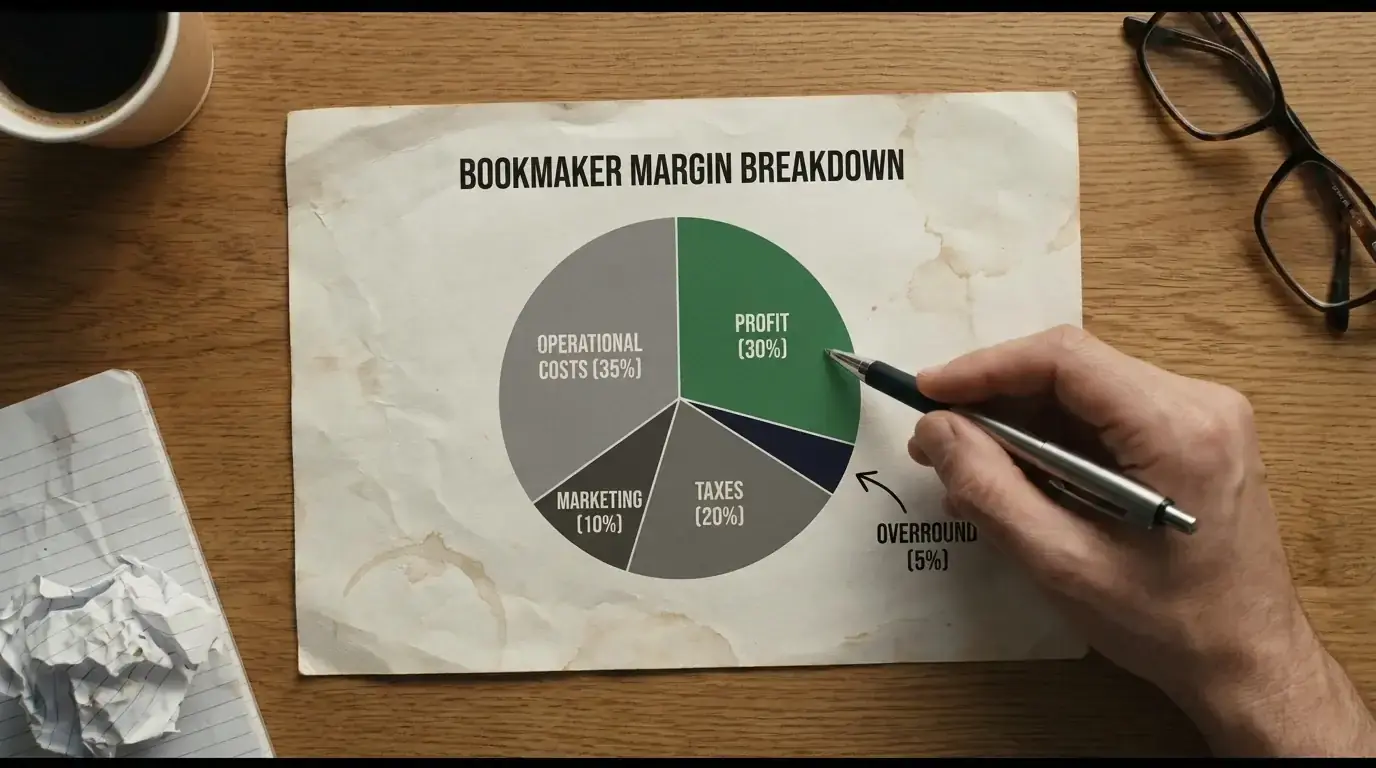
The overround is the bookmaker’s built-in margin. If the true probabilities of all outcomes sum to 100%, the bookmaker prices them to sum to 104-108%, pocketing the difference. A tighter overround means better value for the bettor. The UK remote betting sector generated £7.8 billion in gross gaming yield during the year ending March 2025 — a 13.1% year-on-year increase — and every pound of that revenue comes partly from the overround built into every market.
Ice Hockey-Specific Terms for Bettors
Five-on-five refers to even-strength play with five skaters plus a goaltender per side. Most advanced hockey analytics — Corsi, Fenwick, expected goals — are filtered to five-on-five situations because power plays and penalty kills distort possession metrics. When someone says a team has a 53% CF% at five-on-five, they mean the team generates 53% of all shot attempts when both sides are at full strength.
Corsi counts every shot attempt at even strength: goals, saves, misses and blocked shots. Fenwick does the same but excludes blocked shots. Expected goals assigns a scoring probability to each unblocked shot based on location, type and game context, then sums those probabilities. All three metrics are available for free through public tracking sites and form the analytical backbone of model-based hockey betting.

The empty net is a pivotal concept for bettors. When a team trails late in a game, the coach removes the goaltender and sends an extra skater onto the ice, creating a six-on-five situation. This produces goals at an elevated rate in both directions — the attacking team scores from the numerical advantage, the defending team scores into the vacated cage. Empty-net goals affect totals, puck-line coverage and period scoring at rates that matter for every bet type.
PDO measures the combination of a team’s shooting percentage and save percentage. A PDO near 1.000 is sustainable; significantly above or below indicates luck that will regress toward the mean. Teams riding a PDO of 1.030 are likely to cool off; teams suffering at 0.970 are due for improvement. Bettors who track PDO can identify teams whose recent results overstate or understate their true quality.
The salary cap — $95.5 million for the 2025-26 season, projected at $104 million for 2026-27 — limits how much each team can spend on player salaries. Cap pressure forces trades, limits free-agent signings, and shapes roster construction. For bettors, the cap is relevant because teams pressed against it carry less depth and are more vulnerable to injuries, while teams with cap space can improve through mid-season trades.

UK-Specific Betting Language Applied to Hockey
Acca — short for accumulator — combines multiple selections into a single bet. Each leg must win for the acca to pay out. The compounding odds produce large potential returns, but the compounding probability of failure makes accas a high-variance instrument. In hockey, correlation between legs (same conference, same schedule block) is a common trap. The 10% of UK adults who participate in sports betting are well acquainted with accas from football; the same principles apply to hockey, with the added complexity of lower-scoring outcomes.
Each-way betting does not exist in hockey in the same form as horse racing, but the regulation-time three-way market serves a similar function. Backing a team to win in regulation is the “win” component; the draw at regulation time offers a separate betting option that pays out if the game goes to overtime. When two evenly matched teams meet and the draw probability exceeds the 23-25% baseline, the regulation-time draw can be a value play that UK bettors familiar with the three-way football market will find intuitive.
Juice — also called vig or vigorish — is the bookmaker’s commission built into the odds. A moneyline priced at -110 on both sides carries 4.5% juice. In hockey, the juice on standard markets runs from 4% to 8% depending on the platform and market type. Line shopping across multiple bookmakers reduces the effective juice you pay, which is why maintaining three or more active accounts is essential for serious hockey bettors.
Andrew Rhodes, the chief executive of the UK Gambling Commission, has framed the regulatory outlook as one focused on preventing harm while allowing adults to gamble freely. That philosophy shapes the UK market in ways that directly affect hockey bettors: licensed operators are required to offer responsible gambling tools, and 84% of US bettors report awareness of such tools — a figure the UK market mirrors. Understanding these tools and using them as part of a disciplined bankroll strategy is not an afterthought; it is part of the professional bettor’s toolkit.

The responsible gambling guide covers how to set deposit limits, cooling-off periods and self-exclusion options across UK platforms, ensuring that the glossary knowledge you build here is applied within a sustainable framework.
