

The EIHL Is Growing — and So Are Its Betting Markets
I walked into the Motorpoint Arena in Nottingham on a Saturday night four years ago expecting a half-empty barn and a novelty sport. What I got was 7,000 screaming fans, hits that rattled the glass, and a Panthers-Steelers rivalry that felt as visceral as any Premier League derby I have attended. That night changed my view of British ice hockey completely — and when I checked the betting markets afterwards, I realised the bookmakers had not caught up to what was happening inside those arenas.
The EIHL is the real deal, and the numbers prove it. The league recorded 1,321,128 fans through the turnstiles in 2025-26 — a fourth consecutive season of record attendance. The average crowd hit 3,863 per game, up from 3,660 the previous year and 3,148 in the 2022-23 season when the league first cracked the one million barrier. Ice hockey is now the most attended indoor professional sport in Britain and sits third overall among winter sports behind football and rugby. Gary Bettman, the NHL commissioner, said it plainly at this year’s Stanley Cup press conference: every platform and every source of revenue is growing. The same applies to the EIHL, albeit on a smaller scale — and where growth outpaces market attention, there is value for bettors willing to pay attention.

The betting markets are expanding alongside the fanbase. Three seasons ago you were lucky to find pre-game moneylines for EIHL fixtures at more than a handful of UK bookmakers. Now, most major platforms carry match winner, totals and occasionally puck line markets for every regular season game. The depth is still thin compared to the NHL, but the trajectory is clear, and the thinner the market, the softer the odds — which is exactly the environment where a bettor with local knowledge can thrive.
I have spent the past four seasons betting the EIHL alongside my NHL work, and the returns have been disproportionately good relative to the time invested. The reason is simple: the pricing in EIHL markets is less efficient because fewer sharp bettors are paying attention, the data infrastructure is limited, and the bookmakers are pricing games with less granularity than they apply to higher-profile leagues. If you are a UK-based hockey bettor, ignoring the EIHL is leaving money on the table.
EIHL Teams and What Makes Them Tick
You cannot bet intelligently on the EIHL without understanding its structure, and the structure is unlike any other European hockey league. Ten teams compete across England, Scotland, Wales and Northern Ireland, each operating under a salary cap that is tiny by North American standards but enforced tightly enough to create genuine parity. The Belfast Giants, Sheffield Steelers, Nottingham Panthers, Cardiff Devils and Coventry Blaze are the names that casual fans recognise, but in any given season a team like the Dundee Stars or the Glasgow Clan can upset the hierarchy if they recruit well in the off-season.
Roster turnover is the defining feature. EIHL teams rebuild significantly every summer, importing players from North American minor leagues, European second-tier circuits and NCAA programmes. A team that finished bottom in March can look completely different by September, and the bookmaker’s pre-season odds often rely on brand reputation rather than the actual roster assembled. I start my EIHL season by tracking import signings from late June onwards and comparing the new rosters to the previous year’s performance metrics. Teams that have upgraded their goaltending and their top-six forwards without losing their core British players tend to outperform early-season expectations.

The league calendar creates its own betting dynamics. Weeknight games between nearby rivals — Sheffield at Nottingham, Cardiff at Coventry — tend to be tight, low-scoring affairs where home ice matters more because the away fans travel in numbers and raise the intensity. Weekend double-headers, where teams play Saturday and Sunday, produce a classic fatigue angle: the team travelling on Sunday is almost always at a disadvantage, especially if Saturday’s game went to overtime or featured a physical, penalty-heavy contest.
Goaltending is even more decisive in the EIHL than in the NHL. Most teams carry two goaltenders, and the gap in quality between the starter and the backup can be enormous. A number one import goalie posting a .920 save percentage paired with a British backup at .890 creates a situation where knowing which netminder is starting is the single most important piece of pre-game information. Some teams announce their starters on social media the morning of the game; others keep it quiet until warmups. Being plugged into those information channels is not optional — it is the foundation of any serious EIHL betting approach.
Understanding these patterns is the starting point. The deeper comparison between EIHL and NHL betting dynamics is something I explored in a dedicated piece on what changes when you switch leagues, but the short version is: the EIHL rewards local knowledge and penalises anyone who tries to apply NHL-style statistical models without accounting for the league’s unique characteristics.
What Markets UK Bookmakers Actually Offer for EIHL
Last Wednesday I checked five UK bookmakers for an EIHL regular season game — Belfast Giants at home to the Fife Flyers. Three offered match winner only. One had match winner and over/under 6.5 goals. One carried match winner, totals and period betting. That spread of coverage tells you everything about where EIHL betting stands in 2026: growing, uneven, and full of opportunity if you know where to look.
The match winner market is available almost everywhere for EIHL games and is where most of the betting volume sits. Odds are set based on a combination of league standings, recent form and — to a greater extent than in the NHL — the bookmaker’s subjective assessment of team quality. Because the stat infrastructure for the EIHL is limited compared to the NHL, pricing is less algorithmic and more opinion-based, which means mispricings happen more often. I have seen games where two bookmakers differed by as much as 0.30 on the same team’s moneyline, a spread that would be almost unheard of for an NFL or Premier League fixture. That price dispersion alone justifies keeping accounts at multiple platforms.
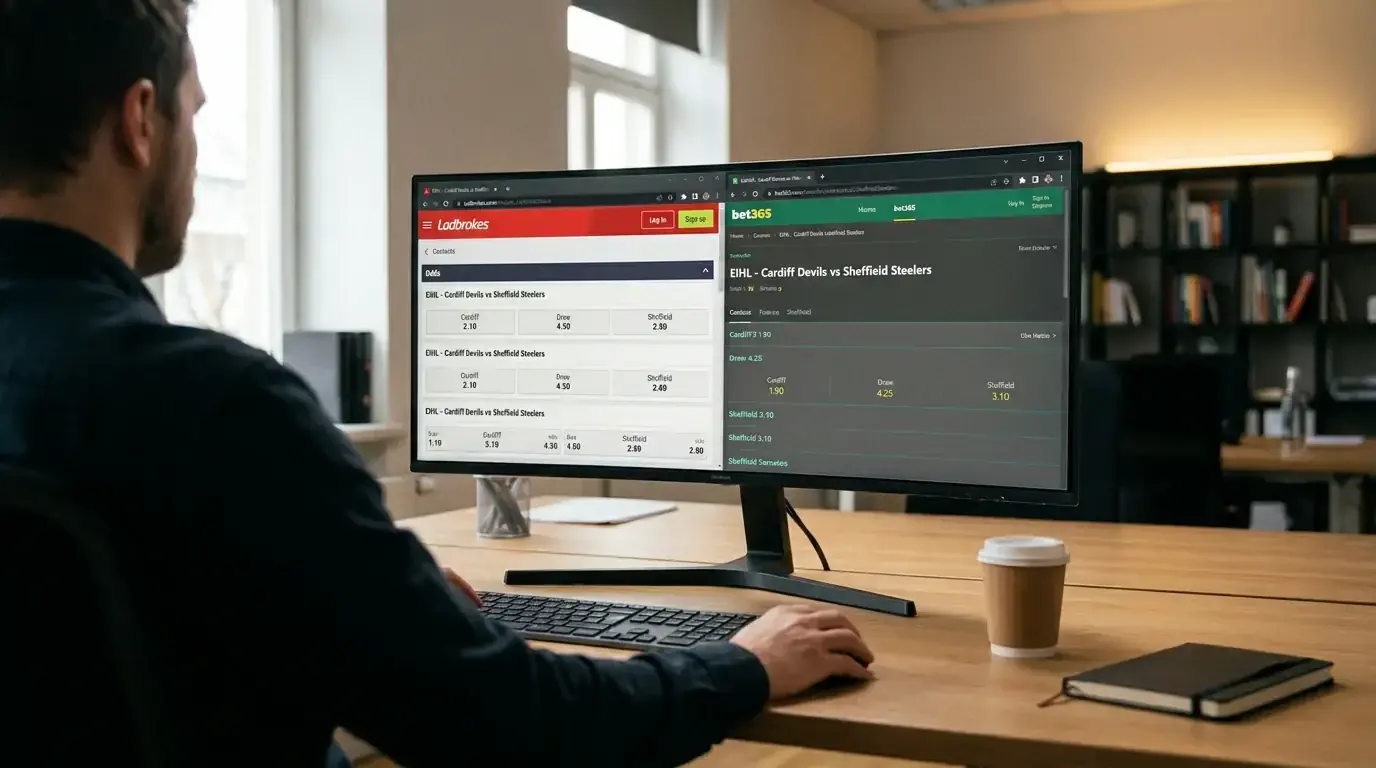
Totals markets have become standard on the larger platforms. The most common line is 6.5 goals, reflecting the EIHL’s generally higher-scoring style compared to the NHL. Some bookmakers offer 5.5 or 7.5 as alternatives, but the liquidity on those lines is thin and the overround can be punishing. I stick to the 6.5 line and only bet when my assessment of the matchup suggests a clear lean toward over or under.
Puck line betting on EIHL games is available but inconsistent. When it appears, the standard +/-1.5 line is usually offered at prices that reflect the bookmaker’s uncertainty — wider overrounds than equivalent NHL puck lines, which means you need a stronger edge to justify the bet. Player props are essentially nonexistent for the EIHL. First goal scorer markets pop up occasionally for marquee fixtures — playoff games and Challenge Cup finals — but they are the exception rather than the rule. Remote betting GGY in the UK stands at approximately $2.4 billion across all sports, and ice hockey’s slice remains modest. As the EIHL fanbase grows, the market depth will follow, but for now you work with what is available.
EIHL-Specific Betting Strategies
Every strategy I use for EIHL betting starts with a question the NHL model never asks: who is actually in the building? I do not mean the fans — I mean the players. EIHL rosters are smaller and less deep than NHL rosters, so a single injury or suspension can swing a game outcome far more dramatically. If Sheffield’s top import forward is out with a lower-body issue that was mentioned on the team’s social media but not picked up by the bookmaker, that is actionable intelligence. I follow every EIHL team’s official channels and several fan forums to catch injury and lineup news that the wider market misses.
The home-away split in the EIHL is more pronounced than in the NHL. Smaller arenas, louder crowds and the familiarity of home ice create a measurable boost for the home side. I weight home advantage more heavily in my EIHL assessments than in my NHL model, particularly for teams with passionate fanbases and loud, compact arenas like Nottingham and Belfast. When a strong home team is hosting a mid-table opponent on a Saturday night with a sell-out crowd expected, the moneyline often underprices the home edge because the bookmaker is anchoring to the league table rather than the situational factors.
Weeknight-versus-weekend analysis is another EIHL-specific angle. Teams that play on a Wednesday and then again on Saturday have had three full days to recover. Teams on a Saturday-Sunday double-header face the fatigue factor. I track each team’s record on the second game of a weekend double, and the results are striking: the Sunday team that travelled after a physical Saturday game loses at a rate significantly higher than their season average suggests. It is the closest thing to a free angle that exists in EIHL betting. The travel distances are shorter than in the NHL, obviously — you are crossing the Midlands, not the continent — but the effect is still measurable because EIHL players are not full-time professionals in the NHL sense. Many have day jobs, conditioning programmes vary widely between clubs, and the recovery infrastructure is a world apart from what an NHL franchise provides.

Seasonal phasing matters too. The EIHL regular season runs from September to March, followed by playoffs. Early-season games — September and October — are chaotic because new rosters are still gelling and coaches are experimenting with line combinations. I bet lighter in those months and increase volume from November onwards, when the roster has stabilised and the data sample becomes more meaningful. Playoff betting demands a different approach entirely: the intensity increases, goaltending becomes even more important, and the smaller best-of series format introduces enormous variance.
One more angle worth mentioning: the Challenge Cup and other in-season competitions. These tournaments run alongside the regular season, and teams sometimes rest key players or use altered lineups for cup fixtures while focusing on the league standings. Bookmaker odds for Challenge Cup games are often based on the teams’ league form, which does not account for the lineup changes. If you can confirm that a team is resting its import goalie and two top forwards for a mid-week cup game, the opponent’s price suddenly looks far more attractive than the headline odds suggest. It is a small edge, but it recurs throughout the season.
Dealing With Limited Stats and Smaller Samples
If you come to the EIHL from an NHL betting background, the first thing you will notice is the data desert. There is no public Corsi tracker, no expected goals model, no shot-location heat maps. The EIHL publishes box scores with goals, assists, penalty minutes and shots on goal, and that is about it. For a data-driven bettor, this feels like going from a five-star buffet to a vending machine.
But limited data does not mean no data. Shots on goal, power play conversion rates and penalty kill percentages are available from the league’s official site, and they stabilise quickly in a league that plays around 60 regular season games. I build a basic model using three inputs: shots on goal differential (a rough proxy for possession), special teams efficiency, and save percentage for the confirmed starting goalie. It is cruder than my NHL model, but in a market where most punters are betting on reputation and gut feeling, even a crude model provides an edge.
Small samples are the bigger challenge. A ten-game rolling window in the NHL represents about 12% of the season. In the EIHL, ten games is roughly 17% of the season, which means each game carries more statistical weight and individual outliers have a larger effect on the averages. I compensate by widening my confidence intervals — I need a bigger gap between my estimated probability and the implied probability in the odds before I commit. Where I might bet an NHL game with a 3% edge, I want 5% or more in the EIHL to account for the noise.
The information edge in EIHL betting is less about crunching numbers and more about sourcing intelligence. Attending games in person, following team social media, listening to post-game interviews and engaging with fan communities gives you context that no spreadsheet can capture. A coach who mentions in a post-game interview that his top centre “took a knock” is giving you a signal that may not be reflected in the odds for the next game. In the EIHL, information travels slowly from the rink to the bookmaker’s algorithm, and that delay is your edge.

Another approach I use is building my own shot quality proxy from the game sheet. The EIHL reports total shots on goal for each team, and while this is a blunt instrument compared to NHL shot-location data, the differential over a ten-game window is surprisingly predictive. Teams that consistently outshoot their opponents by five or more per game tend to sustain that advantage over the season, and when the moneyline does not reflect a large shot differential in one team’s favour, I have a potential value bet. It is not sophisticated, but sophistication is overrated in a market where most of the money is bet on instinct.
Arena Atmosphere and Attendance as a Betting Signal
This might sound soft for a data-driven analyst, but I track EIHL attendance figures as a genuine betting input. The logic is straightforward: higher attendance correlates with higher crowd energy, which correlates with a stronger home ice advantage. When the Motorpoint Arena in Nottingham sells out at 7,000-plus, the Panthers play with a visible intensity that they do not always replicate in front of a Tuesday night crowd of 4,500. That difference is real, and it is rarely priced into the odds.

The growth trajectory reinforces this. EIHL attendance has climbed from an average of 2,885 per game in 2021-22 to 3,863 in 2025-26, with year-on-year growth running at roughly 15% as of January 2026. That is not a blip — it is a structural shift in how the British public engages with ice hockey. Before the pandemic recovery, the league first broke the one million total attendance mark in 2022-23 with an average of 3,148 per game. By 2023-24 that climbed to 3,532, then 3,660 the year after, and now the current record. Bigger crowds create a more hostile environment for visiting teams, which in turn makes the home advantage stronger, which in turn makes home moneyline odds more valuable than the pre-season models suggest.
I cross-reference attendance data with specific rivalry fixtures. Belfast against Sheffield, Nottingham against Cardiff, Glasgow against Dundee — these derbies consistently draw the biggest crowds and produce the most intense atmospheres. Home teams in derby fixtures overperform their season average at a rate I find too consistent to ignore. The bookmaker sets the odds based on the teams’ overall records, not on the specific emotional context of the fixture. That blind spot is your edge.
Playoff games amplify everything. Arenas that averaged 3,500 during the regular season sell out at 7,000 for a quarter-final. The noise, the tension, the sheer physicality of playoff hockey in a packed British arena creates conditions where the better team on paper does not always win but the home team almost always competes. I tilt my playoff model toward the home side more aggressively than in the regular season, and EIHL playoff home-ice advantage has rewarded that approach consistently.
The attendance signal also works in reverse. When a team that usually draws 4,000 is playing in front of 2,500 on a rainy Wednesday, the atmosphere deflates and the home edge weakens. I check announced attendance for mid-week cup fixtures and low-profile league games, and if the crowd is noticeably below the team’s average, I reduce my home advantage weighting. It is a small adjustment, but in a league where margins are tight and data is scarce, every reliable signal counts.
